


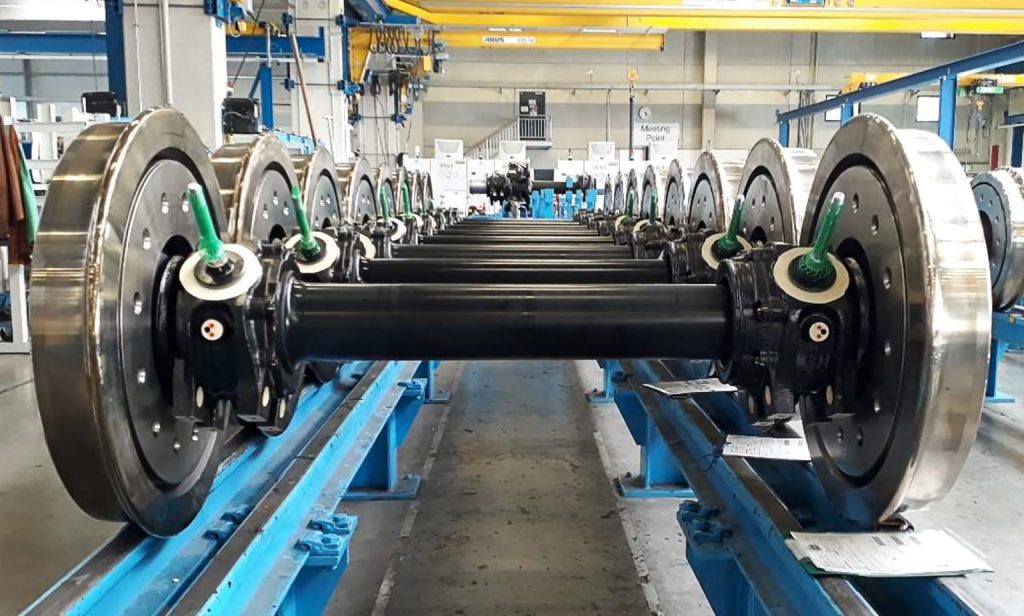
The railway wheelset — two wheels pressed onto a single axle — is arguably the single most safety-critical component in rolling stock. It is the only interface between the vehicle and the rail, bearing the full weight of the loaded wagon while simultaneously guiding the vehicle through curves, transmitting traction and braking forces, and absorbing dynamic impacts at speeds up to 200 km/h and beyond.
Given this responsibility, wheelset spare parts are among the most tightly regulated components in railway engineering. Three European standards govern their design, manufacture and procurement.
EN 13260 — Complete Wheelset Product Requirements
EN 13260 defines the product requirements for assembled wheelsets — the complete wheel-axle assembly. It covers dimensional tolerances for track gauge, back-to-back distance and flange geometry; surface finish requirements at critical locations; and the testing procedures required to validate a wheelset before it enters service.
The standard applies to heavy railway vehicles on all track gauges and sets the framework within which EN 13261 (axles) and EN 13262 (wheels) sit. When procuring a complete wheelset assembly, EN 13260 is the primary compliance reference.
EN 13261 — Railway Axle Product Requirements
EN 13261 defines the material and dimensional requirements for railway axles specifically. The two most common axle steel grades specified are:
EA4T — the standard grade for passenger rolling stock axles, offering high fatigue strength and good toughness at low temperatures. Required tensile strength typically 650–900 MPa depending on axle zone.
EA1N — used predominantly for freight wagon axles where the combination of high axle load and lower speed demands different material properties than passenger applications.
The standard requires full ultrasonic testing (UT) of every axle before despatch, with records traceable to the individual axle by serial number. Surface finish at bearing journals must meet Ra ≤ 1.6 µm — rougher surfaces damage bearing raceways and dramatically reduce bearing service life.
EN 13262 — Railway Wheel Product Requirements
EN 13262 is the key standard for monobloc railway wheels — the solid forged and rolled steel wheels used on the vast majority of European rolling stock. The standard specifies:
Steel grades — ER7 is the most common grade for standard-speed freight and passenger applications. ER8 offers higher hardness and is used on higher-speed passenger rolling stock. Both grades have tightly controlled carbon content and silicon-manganese composition to achieve the required combination of strength and toughness.
Rim hardness — typically 245–305 HB for ER7 wheels. Hardness affects both wear resistance and the risk of thermal cracking during braking.
Residual stress requirements — forging and heat treatment must produce compressive residual stresses in the wheel rim, which resist fatigue crack initiation under the cyclic loading of wheel-rail contact.
Fatigue strength — EN 13262-compliant wheels certified to the highest quality level (QR) achieve 500,000–700,000 km before re-profiling is required. Lower-grade wheels may require re-profiling after only 300,000–400,000 km, significantly increasing total lifecycle cost.
The most commonly procured specification across European freight operations is the 920 mm monobloc wheel to EN 13262 grade ER7, for standard 1,435 mm gauge wheelsets with 22.5-tonne axle load.
The Press-Fit: A Critical Parameter Often Overlooked
When a wheel is fitted to an axle, it is pressed on using an interference fit — the wheel bore is slightly smaller than the axle journal, so the wheel must be pressed on under high force using a hydraulic press. The interference fit specification — typically 0.15–0.25 mm — determines the pull-off resistance of the wheel in service.
Too little interference and the wheel can slip on the axle under braking loads. Too much and the press-fit process risks damaging the axle surface. Press-fit force must be recorded on a press-fit chart during wheelset assembly, and this chart must be retained as part of the wheelset’s technical documentation throughout its service life.
Bearing Selection for Wheelset Spare Parts
The wheelset bearings — housed in the axle boxes — are typically tapered roller bearings or cylindrical roller bearings depending on the bogie design. Key sourcing criteria:
- Dynamic load rating must match or exceed the original specification for the axle load and speed
- Bearing internal clearance must be specified correctly — excessive clearance generates heat and noise; insufficient clearance causes premature failure
- Grease specification must match the bearing manufacturer’s requirements for the operating temperature range
Documentation Required for Wheelset Spare Parts
Complete wheelset: EN 13260 conformity certificate, press-fit chart, dimensional inspection report, UT certificate for axle, mill test reports for both wheel and axle material.
Wheels only: EN 13262 conformity certificate, mill test report showing ER7/ER8 grade, hardness test results, residual stress measurement report.
Axles only: EN 13261 conformity certificate, UT certificate, mill test report, surface finish measurement at bearing journals.
Browse wheelsets and axle spare parts in the Rolling Stock Connect+ catalogue, or contact us for bespoke wheelset assemblies manufactured to your track gauge and axle load specification.
Slug: wheelset-spare-parts-en-13262-en-13261-en-13260-guide Category: Industry Intelligence Target keywords: wheelset spare parts, EN 13262, railway wheelset standards, axle spare parts